



Previous issue | Next issue | Archive
 Volume 16 (2); June 2026
| A review: p53 relationship with long non coding RNAs (lncRNAs) |
Review
A review: p53 relationship with long non coding RNAs (lncRNAs)
Musadiq A.
J. Life Sci. Biomed., 16(2): 12-16, 2026; pii:S225199392600002-16
DOI: https://dx.doi.org/10.54203/jlsb.2026.2
Abstract
The p53 a tumor suppressor gene has been mapped to chromosome that is able to inhibits cellular proliferation and induce apoptosis in response to DNA damage. Under stress, p53 levels rise in the cell and leads to cell cycle arrest in G1 phase. Long noncoding RNAs(lncRNAs) are relatively abundant component of mammalian transcriptome. There are many Long noncoding RNA which are regulated by p53. In this review we have discussed some of the lncRNAs which are related to p53 such as MALAT1, NEATI, LOC285194, LOC401317, PANDA, lincRNA-p21, LincRNA-ROR, lincRNA H19, MEG3 and PURPL. It is very difficult to discriminate between lncRNAs and mRNA. But there are some criteria which can be used to discriminate between protein coding genes and lncRNAs such as, lncRNA genes are shorter and have fewer numbers of exons. Exon in lncRNAs are shorter than protein coding genes. Protein coding genes have protein coding domains as demonstrated by pfam.
Keywords: p53, lncRNAs, apoptosis, DNA damage
[Full text-PDF] [ePub] [Export citation from ePrint] [How to Cite]
| A comprehensive systematic review and bibliometric analysis of housing on growth and reproductive performance of rabbits |
Review
A comprehensive systematic review and bibliometric analysis of housing on growth and reproductive performance of rabbits
Asiedu P, Mohammed MA, Nartey MA and Nketia JD. 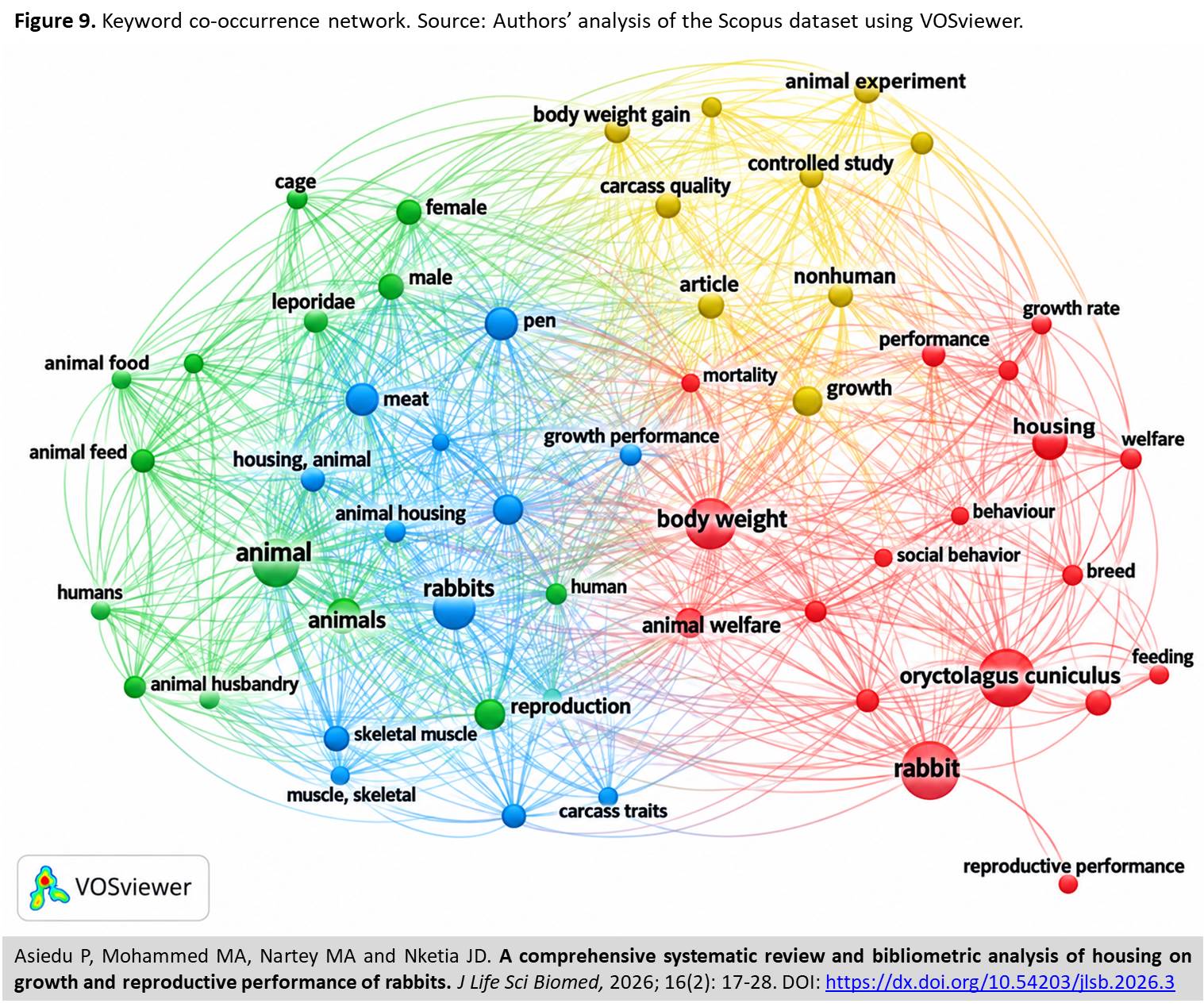 J. Life Sci. Biomed., 16(2): 17-28, 2026; pii:S225199392600003-16
DOI: https://dx.doi.org/10.54203/jlsb.2026.3
Abstract
Rabbit production contributes to animal protein supply and farm income, but housing directly affects welfare, growth and reproductive efficiency. Evidence on rabbit housing is dispersed and sometimes inconsistent. This study systematically reviewed and bibliometrically mapped research on the relationship between housing systems and rabbit growth and reproductive performance. Records were retrieved from Scopus using a structured Boolean search, screened according to PRISMA 2020, and analysed with Bibliometrix in R and VOSviewer. From 130 records, 28 studies met the final eligibility criteria. Hungary recorded the highest country output with 30 documents, followed by Italy with 28 and India with 24, while Italy had the highest country citation count with 55 citations. The most highly cited document in the dataset was the 2007 study by Cabezas and Moreno with 48 citations. Keyword co-occurrence analysis identified four connected themes: housing, welfare and reproductive outcomes; growth performance and physiology; nutrition and feeding systems; and controlled experimentation across housing systems. Collaboration was concentrated mainly in European networks, with limited African representation despite contributions from Egypt, Ethiopia and Nigeria. These findings show that rabbit housing is a life science issue linking animal welfare, physiology, reproduction and food production. Future research should broaden geographical coverage and compare housing systems using integrated welfare and productivity indicators.
Keywords: Growth performance, Housing system, Rabbits, Reproductive performance, Welfare
[Full text-PDF] [ePub] [Export citation from ePrint] [How to Cite]
Previous issue | Next issue | Archive
 This work is licensed under a Creative Commons Attribution 4.0 International License (CC BY 4.0)
