





Previous issue | Next issue | Archive
 Volume 16 (3); September 2026
| Artificial intelligence applications in pediatric hematology and oncology: current advances and future perspectives |
Review
Artificial intelligence applications in pediatric hematology and oncology: current advances and future perspectives
Kurucu B.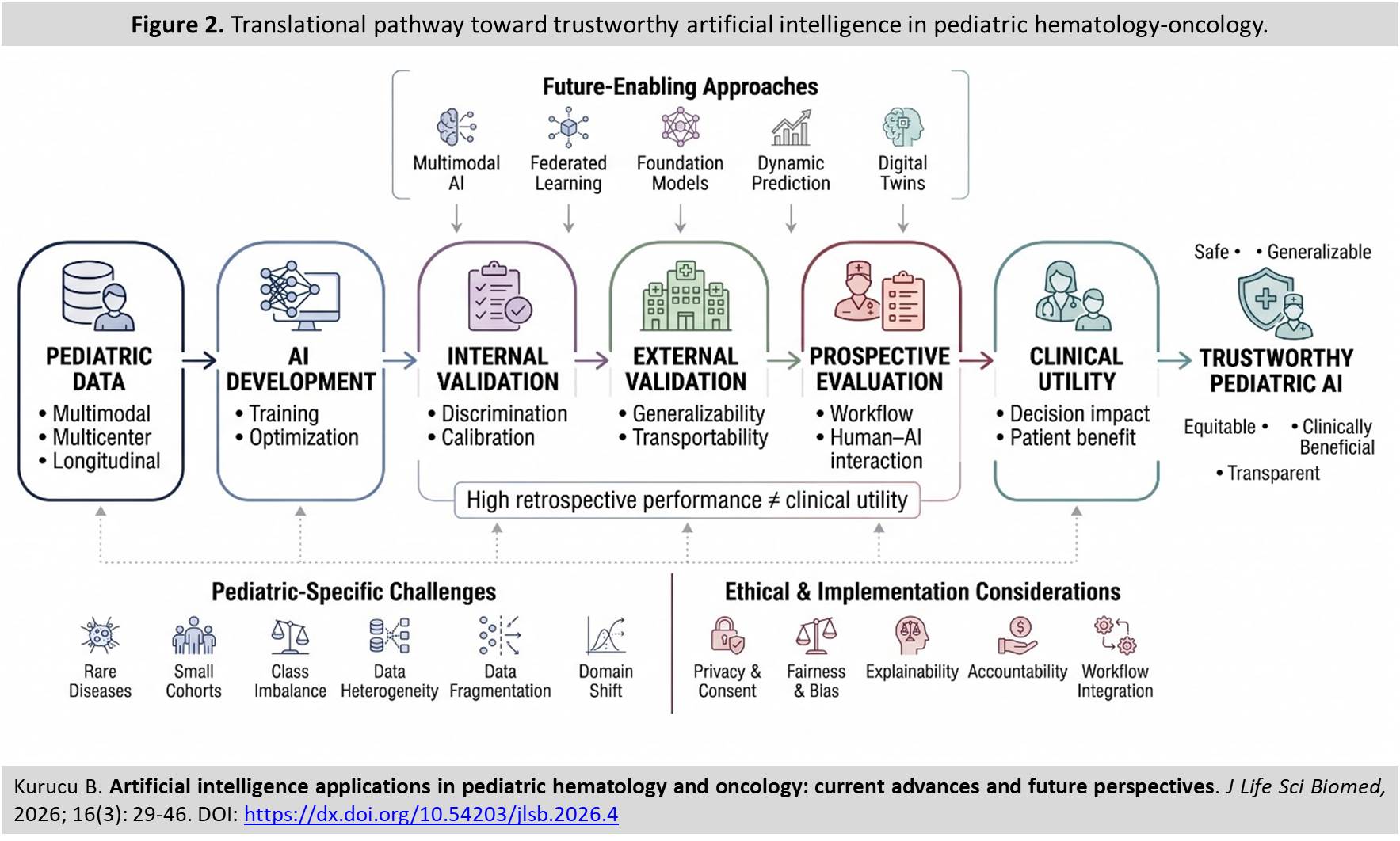 J. Life Sci. Biomed., 16(3): 29-46, 2026; pii:S225199392600004-16
DOI: https://dx.doi.org/10.54203/jlsb.2026.4
Abstract
In pediatrics, hematology and oncology, artificial intelligence (AI) is increasingly being studied as a way to retrieve clinically meaningful information from complex and heterogeneous biomedical data. This narrative review critically reviews the current use of AI, machine learning, and deep learning in the management of malignancies and solid tumors in children, as well as benign hematological disorders, highlighting their translational potential. Applications that are emerging include automated blood and bone marrow morphology, medical imaging and digital pathology, disease classification, measurable residual disease evaluation, risk stratification, treatment-response and relapse prediction, toxicity evaluation, and survival modelling. The evidence is more robust for use in acute lymphoblastic leukemia, and less so in acute myeloid leukemia and lymphoma in children with hematological malignancies. AI-based imaging and radiomics are more extensively studied in central nervous system tumors than in other pediatric solid tumors, for which the evidence remains less mature. While there has been some progress in encouraging performance across multiple applications, the majority of studies are retrospective, single centre or relatively small in size with limited external validation and prospective testing. There are many obstacles to clinical translation, such as small pediatric populations, disease rarity and heterogeneity, data fragmentation, algorithmic bias, explainability, and workflow integration issues and concerns. The development of multimodal and longitudinal AI, foundation models, federated learning, and dynamic prediction systems combining clinical, imaging, pathology and multi-omics data are anticipated to be key areas of future progress. The role of AI in the field of pediatric hematology-oncology will be determined not just by algorithmic performance, but by strong evidence supporting the benefit of human-AI collaborations within the clinical decision-making process in terms of improved patient outcomes, clinical safety and equity.
Keywords: Machine learning; deep learning; pediatric hematology; pediatric oncology; childhood cancer; leukemia; precision medicine
[Full text-PDF] [ePub] [Export citation from ePrint] [How to Cite]
| Sero-prevalence and associated factors of syphilis among blood donors in Debre Marko’s blood Bank Northwest Ethiopia |
Research Paper
Sero-prevalence and associated factors of syphilis among blood donors in Debre Marko’s blood Bank Northwest Ethiopia
Abebe A, Girmay G, Woldegerima E, and Belete D.
J. Life Sci. Biomed., 16(3): 47-54, 2026; pii:S225199392600005-16
DOI: https://dx.doi.org/10.54203/jlsb.2026.5
Abstract
Several infectious diseases have been found to be associated with transfusion of blood and blood components. From those, syphilis is a sexually and transfusionally transmittable disease that is caused by Trepanoma pallidum. Trepanoma pallidum is one of the oldest recognized infectious risks of blood transfusion and poses a challenge to the safety of the blood supply. Therefore, the aim of this study is to determine the sero-prevalence and associated factors of syphilis among blood donors in Debre Marko’s blood bank, Northwest Ethiopia. A Hospital-based cross-sectional study was conducted from February 1 – April 30/2021. The socio-demographic data and associated factors were collected using a structured questionnaire and blood samples were collected by convenient sampling technique and tested for anti-syphilis Ab: using DIALAB ELISA (Nora Kampitsch, MSc, India). The data was coded, cleaned, and analyzed by SPSS version 23. The binary logistic regression model was used to investigate factors associated with syphilis. A p-value of < 0.05 at multivariable analysis was considered statistically significant. Among 223 participants, the prevalence of Syphilis infections was 7 (3.13 %).Those blood donors with unsafe sex (AOR= 5.34; 95%CI: 1.87–27.5), aged of ≥35 years (AOR = 3.5; 95% CI: 1.3- 17.4) and number of donation (AOR = 3.87; 95%CI: 1.08-11.9) were significantly associated with Syphilis infections. In this study, the sero-prevalence of syphilis infection was 3.13%. Factors such as practice unsafe sex, age and number of donations were significantly associated with syphilis infections. Improvement in monitoring, surveillance and evaluation of transfusion-transmitted infections and sexually transmitted infections is very important. In addition to the rapid tests and ELISA, more sensitive assay methods like polymerase chain reaction (PCR) should be included in future prospective studies with large sample size to screen for syphilis infections.
Keywords: Syphilis, blood donors, Debre-markose Ethiopia
[Full text-PDF] [ePub] [Export citation from ePrint] [How to Cite]
| Rethinking emergency medical services interactions with individuals with special needs: a clinical and communication perspective |
Research Paper
Rethinking emergency medical services interactions with individuals with special needs: a clinical and communication perspective
Zoltowski-Siordia S.
J. Life Sci. Biomed., 16(3): 55-58, 2026; pii:S225199392600006-16
DOI: https://dx.doi.org/10.54203/jlsb.2026.6
Abstract
Effective communication is a cornerstone of high-quality emergency medical care (EMS). However, traditional communication methods often fall short when applied to patients with special needs, including those with autism spectrum disorder (ASD), Down syndrome, traumatic brain injury (TBI), cerebral palsy, and other developmental disabilities. These populations present with distinct neurological, sensory, and behavioral presentations that require adapted communication strategies and clinical approaches. This article explores the foundation of these differences and provides practical recommendations for EMS personnel to enhance patient safety, reduce unnecessary escalation, and improve overall care.
Keywords: Emergency medical care, developmental disabilities, patient safety
[Full text-PDF-inpress] [ePub] [Export citation from ePrint] [How to Cite]
Previous issue | Next issue | Archive
 This work is licensed under a Creative Commons Attribution 4.0 International License (CC BY 4.0)
